Whose Accountability, Exactly?
One minister resigned. One law changed at the center. Neither answers the question regarding real accountability.
In May 2026, a leaked NEET-UG paper forced the cancellation of India's national medical entrance exam. Six weeks of protest followed at Delhi's Jantar Mantar, led by a group calling itself the Cockroach Janta Party, pulling in Sonam Wangchuk's hunger strike and national attention, and ending with Education Minister Dharmendra Pradhan's resignation on 25 July and a tougher anti-paper-leak law clearing Parliament days later. The resignation got treated, almost everywhere, as the story's natural end point — the person responsible, held responsible. But a single minister resigning in Delhi was never going to be the whole answer to a failure this large, or this shared.
Education in India isn't a Union List subject, sitting entirely with Delhi. Since the 42nd Constitutional Amendment in 1976, it's on the Concurrent List — a shared responsibility between the Centre and every state government, each of which runs its own piece of the machinery that a national entrance exam ultimately depends on. That single fact quietly undercuts a lot of the accountability story as it got told this summer. A minister in Delhi resigned over NEET. But NEET security, coaching-centre regulation, and exam-leak prevention have never lived only in Delhi — they live, just as much, in every state capital that touches the pipeline.
Which raises an obvious question this story never really sat with: if this was ever about the principle, rather than the party, why did the pressure only ever point one direction?
Start with Punjab, since it's the most direct parallel. Punjab has its own live paper-leak controversy, serious enough that the BJP has been publicly demanding the resignation of Punjab's education minister over it — the same demand, aimed at the same category of failure, just pointed at a different party. CJP's silence on that front is more explicable once you know that both the group's founder, Abhijeet Dipke, and its spokesperson, Ashutosh Ranka, have prior associations with the Aam Aadmi Party — the party that governs Punjab. None of this proves the movement was ever an AAP front, and it's important to say that plainly: association isn't affiliation, and plenty of people carry old party ties into causes that have nothing to do with them. But a movement that presents itself as answering to principle rather than to party owes an explanation for why the principle stopped at one state's border. CJP hasn't offered one.
But this isn't just a CJP problem, or an AAP problem — and narrowing it to one movement and one party would itself be a kind of dishonesty. The same pattern runs straight through the Congress party, which has been among the loudest voices demanding Pradhan's resignation nationally.
Karnataka is Congress-governed, and on 26 July 2026 — the day after Pradhan actually resigned — Chief Minister D.K. Shivakumar announced that Deputy Commissioners would henceforth be held accountable for recruitment exam paper leaks in his own state, following the Karnataka SSLC and 2nd PUC preparatory exams having their own leak controversy. BJP leader R. Ashoka called this "political hypocrisy" in near real time, naming Rahul Gandhi, Priyanka Gandhi, and Shivakumar directly: demanding resignations in Delhi while quietly tightening accountability at home, only after the same national pressure made it impossible not to. A week earlier, on 19 July, Karnataka's own Congress president, B.K. Hariprasad, had stood in Bengaluru demanding a Supreme Court-monitored probe into paper leaks nationwide and reiterating the call for Pradhan's resignation — from a state that, by his own government's admission a week later, had exam-security problems of its own that nobody outside Karnataka was demanding anyone resign over.
Rajasthan adds a longer, older version of the same story. During the Lok Sabha's debate on the anti-paper-leak bill on 28 July 2026, a BJP MP told the House that 17 of 19 major paper leaks in the state had occurred while Congress governed it — a claim made on the floor of Parliament, not an anonymous allegation, though it's worth noting it was made by an opposing party and hasn't been independently tallied here. What isn't in dispute is that Rajasthan's paper-leak problem under Congress rule has been a recurring national talking point for years, invoked and re-invoked by whichever party finds it useful in the moment. Priyanka Gandhi, in that same debate, cited a genuinely staggering national figure — 152 paper leaks in the last decade, affecting 7.5 crore students, with not one person from any leak mafia ever convicted — a number that indicts the entire system, every state, every party that has held power somewhere in that decade. She said the demand for accountability belonged to "the entire nation," not to Congress alone. She was right. She just didn't apply it to Karnataka or Rajasthan in the same breath.
Put Punjab, Karnataka, and Rajasthan next to each other and a pattern emerges that's bigger than any single party's hypocrisy: everyone in this story reaches for accountability exactly once — pointed at whoever is inconvenient to them at that moment — and goes quiet the instant the same standard would apply to their own house. That isn't a Congress problem, or an AAP problem, or, for that matter, a BJP problem when the roles reverse in some other state next year. It's the actual shape of "political theatre" this series keeps circling: not that any one party is uniquely dishonest, but that accountability has become a weapon everyone reaches for and nobody actually wants applied evenly, because applied evenly, it would cost everyone something.
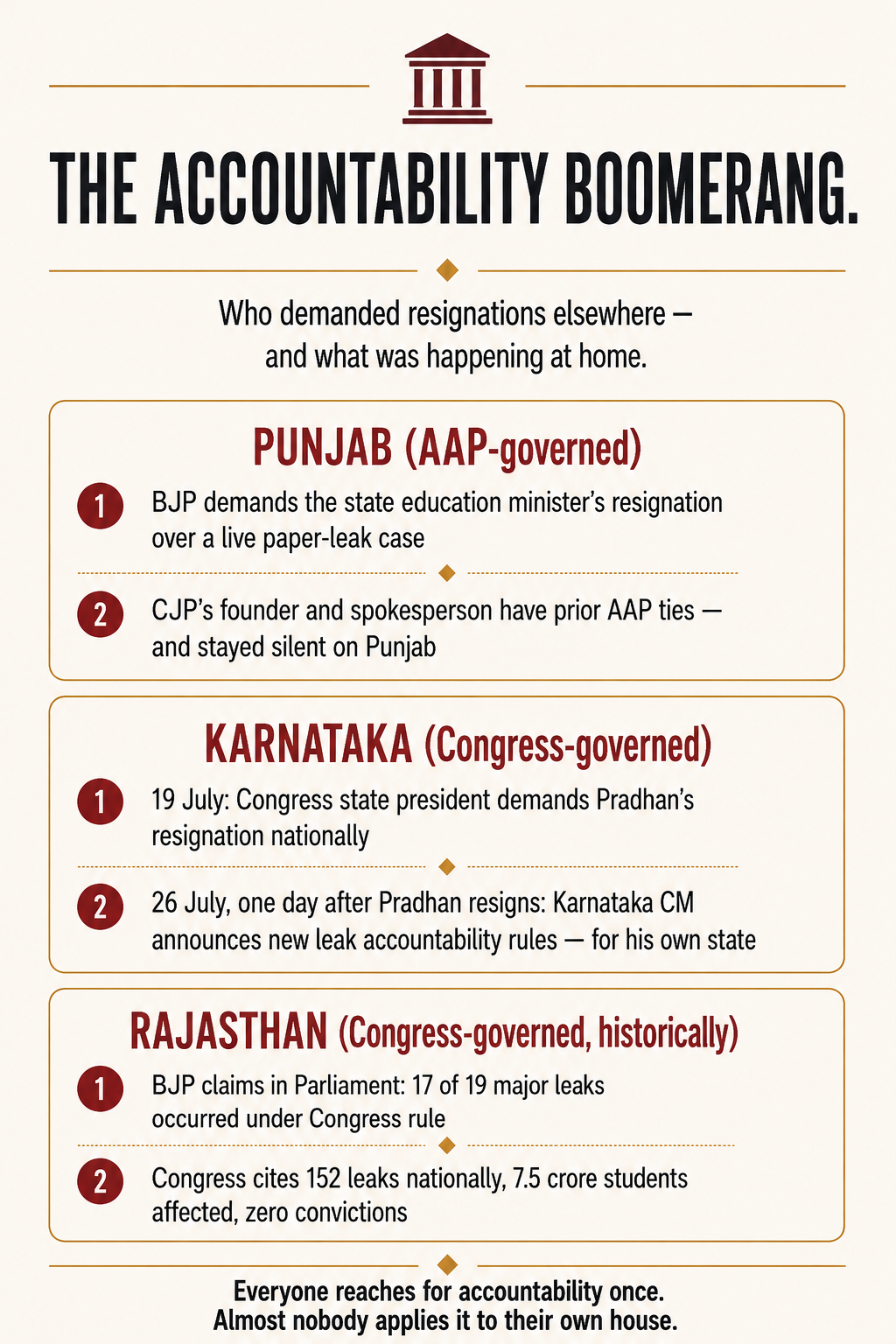
Everyone reaches for accountability once. Almost nobody applies it to their own house.
There's a second thread that runs alongside the protest rather than through it, and it deserves to be stated with real care, because it's easy to overstate and unfair when overstated.
September 2025 — SECMOL's FCRA license cancelled over roughly ₹9.8 lakh in flagged irregularities
September 2025 — separate CBI probe opened into HIAL over ₹1.68 crore in foreign remittances the Ministry of Home Affairs alleges were routed without FCRA clearance
26 September 2025 — Wangchuk arrested under the National Security Act, a day after violence in Leh left four people dead
~170 days held before release in March 2026 — weeks before he joined the NEET hunger strike
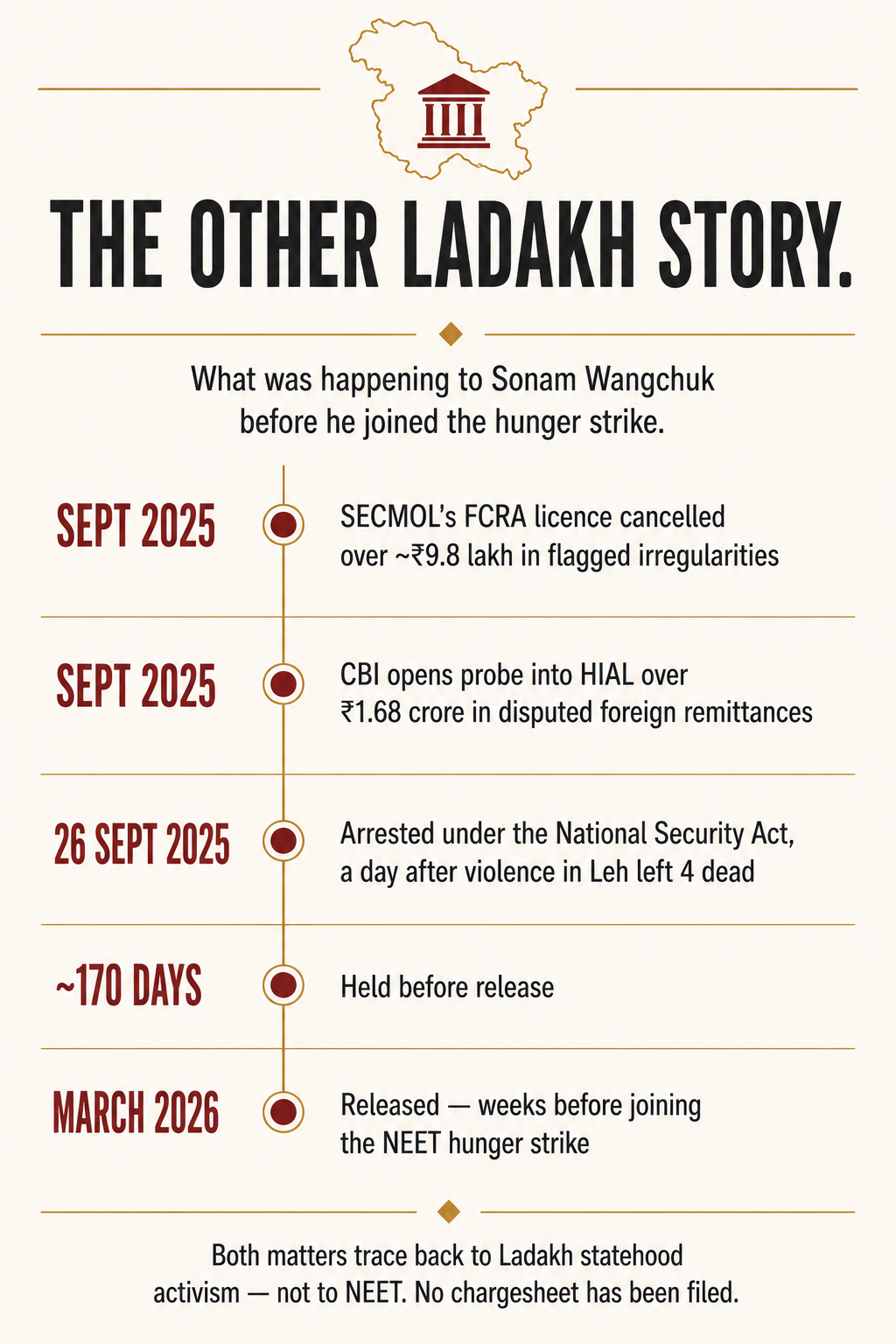
Both matters trace back to Ladakh statehood activism — not to NEET. No chargesheet has been filed.
Both matters trace back to his earlier Ladakh statehood activism, not to NEET or Jantar Mantar at all. His wife has publicly disputed the FCRA findings, and no chargesheet has been filed on the funding allegations. It would be wrong to let any of this controversy colour a reading of his hunger strike here, and that isn't the intent. It's mentioned only because his moral authority was central to how this protest was covered nationally, and readers deserve the full picture of a figure whose credibility did a lot of narrative work in this story — not a verdict on it. This is all information already sitting in the public domain, reported across multiple outlets, about a public figure acting in a public role; noting it isn't an invasion of anything, it's just completing a picture the coverage of this protest left half-drawn.
There's a fourth angle to this — the paid-promotion allegation and the Meta video incident — that turned out to deserve its own full treatment rather than a paragraph here; that thread now has its own piece in this series.
Every argument in this piece so far has been institutional — a minister, a chief minister, a party, a movement's founders. But accountability in this story has quietly meant only one direction the entire time: what the state, the police, and public figures owe citizens. Almost nobody asked what citizens owe back, and the Constitution actually answers that question directly.
Part IV-A, Article 51A, added by the 42nd Amendment in 1976, lists eleven Fundamental Duties every citizen owes in return for their rights. Two apply directly here:
The duty to respect the Constitution and its institutions
The duty "to safeguard public property and to abjure violence" — worded almost as if written for this exact story
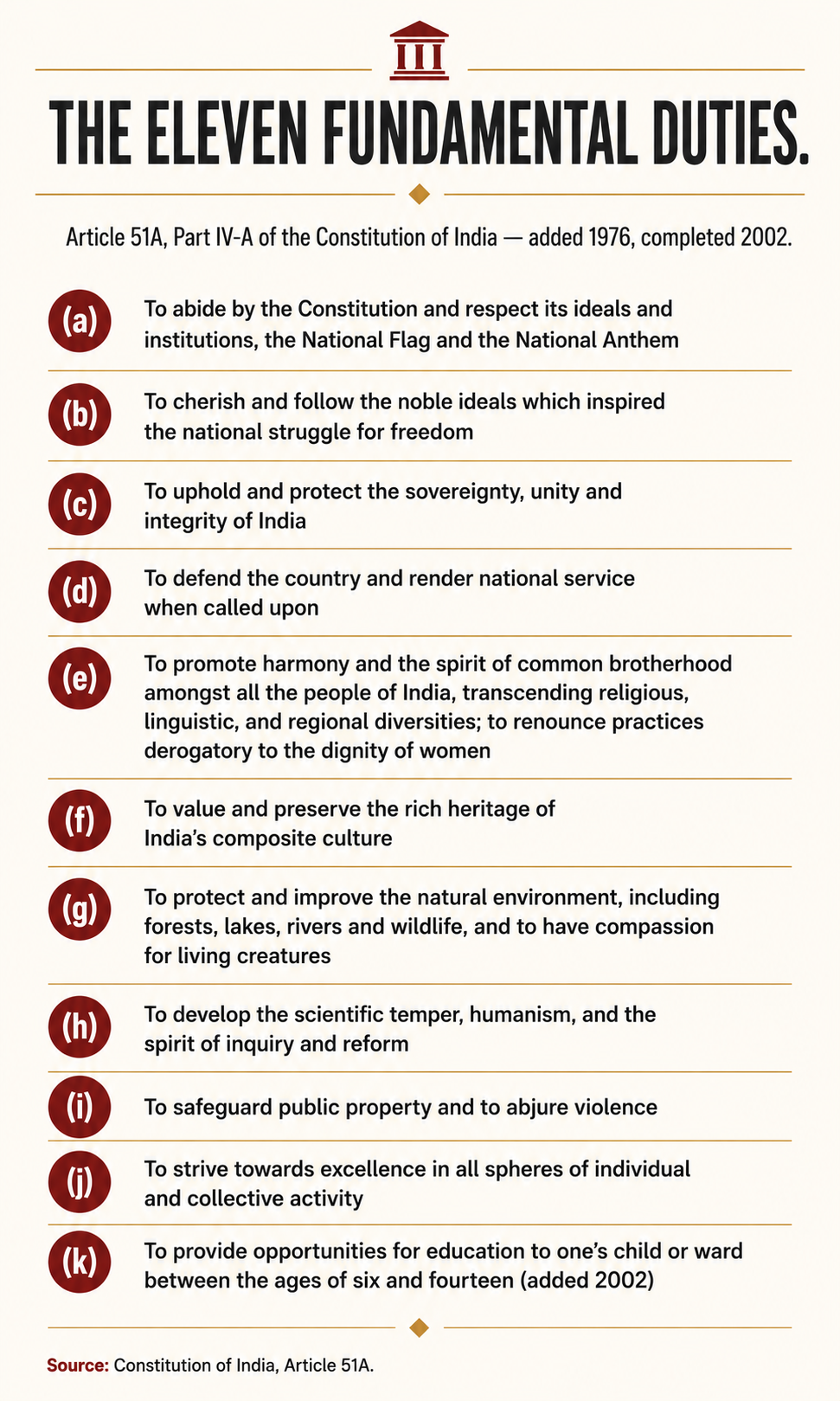
All eleven, Article 51A — not just the two that apply here.
This isn't a call to excuse police excess or wave away the FIR bargain — both of those remain exactly what earlier pieces in this series say they are. It's a narrower, uncomfortable observation: in India, rights get invoked on placards and argued in court constantly. Duties almost never do. A citizen demanding accountability from a minister while never once being asked to account for a brick thrown at a barricade isn't hypocrisy exactly — but it is a one-sided reading of the same document. The Constitution didn't write it as a one-way transaction. Public discourse has simply decided to read it that way.
A cleaner and much more specific question sits inside the compensation demand itself. CJP's founder publicly called on the Prime Minister, in an open letter, for ₹1 crore in compensation for the families of NEET aspirants who died — and the government agreed to it. Compensation for grieving families is not, on its own, a controversial idea; state governments extend it after all kinds of tragedy, and refusing it out of some abstract principle would be its own kind of cruelty. The uncomfortable question is a design question, not a personal one, and it applies to both parties who negotiated the number: does attaching a large lump sum specifically to death-by-exam-failure create an incentive structure nobody intended? That's a policy question about how compensation schemes get designed, aimed at institutions, not a claim about what was in any individual's mind in their final decision. It deserves to be asked plainly and then set down, not narrated further.
Put all of it together, and the accountability question this series keeps circling gets harder to answer, not easier. A minister fell in Delhi. A chief minister quietly tightened rules in Bengaluru the day after, only once the spotlight made it unavoidable. A Rajya Sabha debate cited a decade's worth of failure that indicts every party that has governed anywhere in that decade. And somewhere underneath all of it, a set of older political ties, a funding controversy that predates this protest entirely, and a compensation design nobody fully thought through are still sitting there, unexamined — because a resignation was so much easier to photograph than a system actually being fixed.
This is part of a series. Start with the original essay: While Tightening the Law, Did We Lose the Order? →
Sources
2026 Delhi Jantar Mantar protests — Wikipedia: en.wikipedia.org/wiki/2026_Delhi_Jantar_Mantar_protests
Constitution of India, Seventh Schedule, Concurrent List (as amended by the 42nd Amendment, 1976)
Constitution of India, Part IV-A, Article 51A — Fundamental Duties (42nd Amendment, 1976)
"Karnataka CM holding DCs accountable for question paper leaks henceforth 'political hypocrisy': BJP" — Deccan Herald, 26 July 2026
"DCs will be held accountable for question paper leak henceforth: Karnataka CM Shivakumar" — Deccan Herald, 26 July 2026
"Congress demands SC-monitored probe into exam paper leaks, Pradhan's resignation" — The South First, 19 July 2026
Lok Sabha debate on the Public Examinations (Prevention of Unfair Means) Amendment Bill, 2026 — 28 July 2026, reported by ETV Bharat and Outlook India
Public reporting on SECMOL FCRA cancellation and HIAL CBI probe, September 2025
