The Paid Playbook
Every protest needs people in the street. Not every protest gets there the same way.
In May 2026, a leaked NEET-UG paper forced India to cancel its national medical entrance exam. Six weeks of protest followed at Delhi's Jantar Mantar, led by the Cockroach Janta Party, pulling in Sonam Wangchuk's hunger strike, national media coverage, and eventually a minister's resignation. Somewhere inside that six-week arc, two smaller, stranger threads surfaced and then mostly disappeared from the coverage: a well-known actor went on record alleging she'd been offered payment, flights, and hotel stays to promote the protest online, and a selfie video involving the Prime Minister briefly vanished from Meta's platforms before Meta called it a technical error. Neither thread proves anything on its own. Together, they point at a question bigger than this one protest — a question about how any mass movement actually reaches the size it reaches in 2026, and whether "organic" and "engineered" are even the right words to be arguing about anymore.
Start with the theory that has a real academic home, because it's the least dramatic and the most useful.
RESOURCE MOBILIZATION THEORY
McCarthy & Zald, sociology, 1970s onward
Core claim: social movements don't succeed just because people are angry enough.
Grievance is nearly always present; it's rarely sufficient. What determines whether a movement actually grows is whether it can mobilize resources — money, media access, organizational skill, and crucially, support from people with existing power and platforms, what the theory calls "elite support." By this account, a protest with funding, a coordinated media strategy, and visible backers isn't a corrupted or fake version of a movement. It's simply what a movement that's working looks like. The Civil Rights Movement had funding, lawyers, and organizational infrastructure behind it, and nobody treats that as disqualifying. So when a movement like CJP shows signs of coordination — consistent messaging, visible amplification, apparent access to resources — that alone isn't evidence of anything sinister. It's evidence the movement was, by the only metric that has ever mattered for movements succeeding, doing it right.
Where it gets murkier is the specific claim that some of that amplification wasn't just organized, but paid for and undisclosed — which is where a different, more pointed concept applies.
ASTROTURFING
Political communication research
Core claim: manufacturing the appearance of organic grassroots support while concealing who's actually funding or directing it.
It's called that because it mimics real grass from a distance while being, underneath, something manufactured. Researchers who study it look for specific tells:
Clusters of accounts using near-identical language
Sudden coordinated spikes in engagement
Financial trails that don't match the public face of a movement
None of that is unique to India or to this protest; astroturfing campaigns have been documented across democracies for over a decade, funded by everyone from corporations to political parties to foreign state actors. The actor's on-record allegation — payment, flights, hotels, offered in exchange for online promotion — is, if true, a textbook description of exactly this tactic. It's one account, from one person, about one slice of a six-week movement involving hundreds of thousands of people. It doesn't retroactively fake the grievance that started this — the leaked paper was real, the cancelled exam was real, the anger was earned. But it does mean at least part of the online amplification may not have been what it looked like on a phone screen.
Zoom out one more level and there's a framework some theorists now use for exactly this blurred territory.
FIFTH-GENERATION WARFARE
Daniel Abbott and others
Core claim: the primary battlefield in a modern information conflict isn't physical or even cyber, but perceptual.
The core mechanisms Abbott and others describe are worth naming plainly:
Information weaponization — the strategic deployment of framing and narrative rather than force
Perception management — shaping how a population feels about an event rather than what actually happened in it
Mimetic propagation — the viral spread of emotionally potent content through social platforms, algorithm-assisted, often faster than any fact-check can follow
It's a genuinely contested framework — some scholars use it seriously, others reject the term outright as more metaphor than doctrine — but contested doesn't mean useless, and the underlying phenomenon it's trying to name is not in dispute: information now moves fast enough, and is shaped deliberately enough, that "was this organic" has become a much harder question to answer honestly than it was even a decade ago. Applied here, it doesn't mean Jantar Mantar was a psy-op. It means the tools that make a psy-op possible — algorithmic amplification, paid influence, narrative framing — are also, indistinguishably, the same tools that make a genuine grassroots movement visible in 2026. The technology doesn't know the difference. Increasingly, neither can the public watching it unfold.
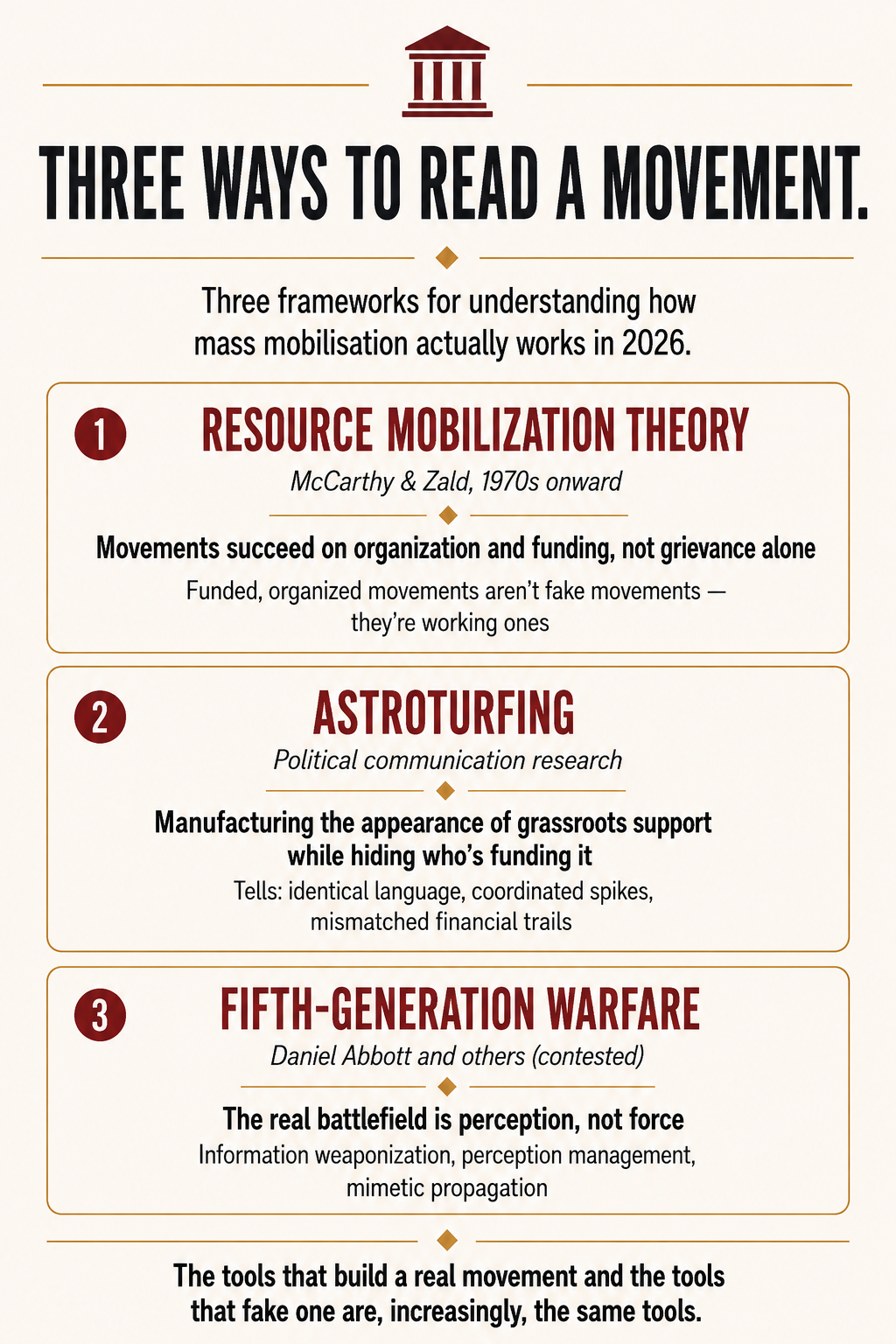
The tools that build a real movement and the tools that fake one are, increasingly, the same tools.
That's exactly why the Meta video incident is worth including carefully, rather than leaving it out. A selfie video involving the Prime Minister disappeared from Meta's platforms during this period; Meta called it a technical error, and nothing has surfaced to confirm it was anything else. Taken alone, it's a footnote. Taken alongside a documented paid-promotion allegation and a movement showing real signs of coordinated amplification, it becomes part of a pattern worth naming even without resolving: every actor in this story — government, movement, platform — was operating in an information environment where the actual mechanics of what reached whom, and why, are close to invisible from the outside. That opacity isn't a flaw in the coverage of this protest. It may be the actual, permanent condition of watching any mass movement unfold from now on.
None of this is an argument that CJP's protest was fake, manufactured, or illegitimate — the underlying grievance was real, and resource mobilization theory says plainly that organization and funding are how legitimate movements succeed, not evidence they aren't legitimate. It's a narrower and, in some ways, more unsettling point: the line between a movement organizing effectively and a movement being engineered from outside has gotten hard enough to see that even the people inside it may not always know which side of that line they're standing on.
This is part of a series. Start with the original essay: While Tightening the Law, Did We Lose the Order? →
Sources
2026 Delhi Jantar Mantar protests — Wikipedia
McCarthy, J. & Zald, M., Resource Mobilization Theory — foundational sociology of social movements, 1970s onward
Astroturfing — political communication research literature
Abbott, D., Fifth-Generation Warfare — theoretical framework, information and perception warfare
ANI / IANS on-record actor interview, July 2026
Public reporting on Meta platform removal of a Prime Minister-related video, July 2026
