While Tightening the Law, Did We Lose the Order?
The law got sharper. Did the state get weaker?
On 30 July 2026, Parliament passed the Public Examinations (Prevention of Unfair Means) Amendment Bill, 2026 — the Lok Sabha on 29 July, the Rajya Sabha a day later, with only the President's assent now pending. The bill sharpens the law considerably:
Longer sentences for organized exam-leak crime
Steeper fines — up to ₹10 crore for service providers
A dedicated Special Task Force
Fast-track courts and a 2-month investigation deadline
On any ordinary day, this would be the whole headline — an Indian institution actually answering public fury with a statute instead of a press conference.
This isn't an ordinary day. And the bill isn't the whole story.
It's the ending of a much longer, messier one. A leaked exam. A resignation. Weeks of unrest at Jantar Mantar. Trace that arc back to where it started, and the bill clearing Parliament starts to look less like a victory lap. It looks more like the one thing in this entire saga that was actually allowed to work the way it was supposed to.
In May 2026, the NEET-UG entrance exam — the gateway over 2.2 million students walk through every year hoping to become doctors — was cancelled. A leaked paper had surfaced online, matching the real one almost word for word. Arrests followed. A CBI probe opened. For a moment, this looked like a familiar Indian scandal: exposed, investigated, absorbed.
It didn't stay that way. From 6 June, a young, chaotically named movement calling itself the Cockroach Janta Party (CJP) turned Jantar Mantar into a sit-in that lasted weeks. Student unions joined. Actors joined. Eventually Sonam Wangchuk joined too, and his hunger strike pulled the whole country's eyes toward Delhi. Stones were pelted. Barricades broke. On 25 July 2026, the minister resigned.
That should have been the end of it. It wasn't. CJP kept pushing — not for the reform bill sitting in Parliament, but for the FIRs against protesters caught on camera to be quietly withdrawn. On 28 July, the Supreme Court's interim order said the government could proceed with those cases anyway. CJP's answer was to threaten to come back to the streets.
Two things happened in this story that deserve to be pulled apart and looked at separately:
The law bent once, under pressure, in a way it shouldn't have
A resignation got mistaken for a fix, when the two are not the same thing at all
Both are the real argument here.
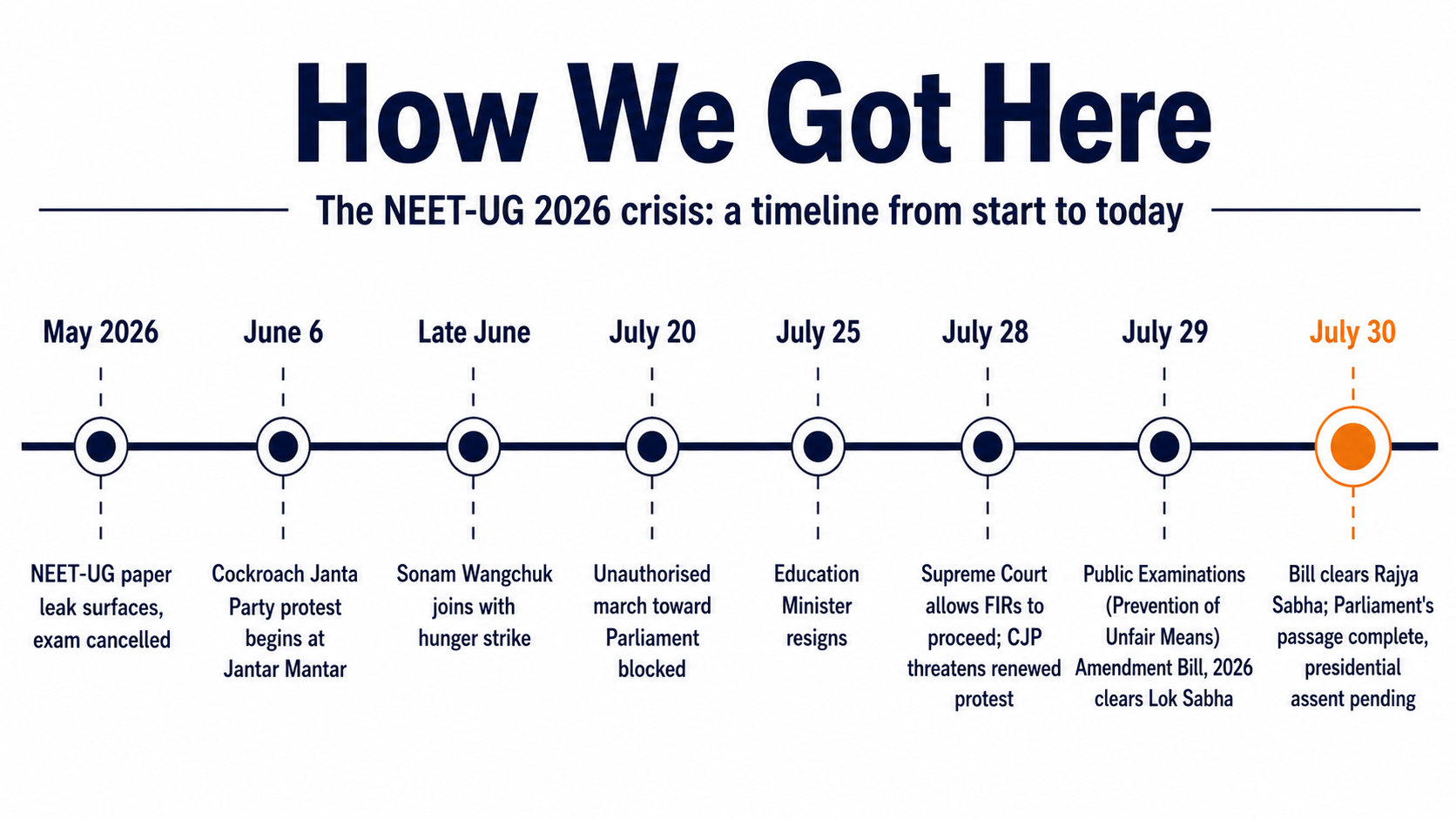
Eight weeks of protests & pressure. One reform — Public Examinations (Prevention of Unfair Means) Amendment Bill, 2026
When the law bent for the street
Start with the part everyone's already seen, because it made the news: footage of stones and sharp debris hurled at police, officers overrun by a crowd, accounts and creators posting abuse at the Prime Minister so raw that Delhi Police formally asked X to hand over the identities behind them. Alongside that footage ran a parallel, murkier story — allegations of incentivized digital promotion, paid posts, coordinated amplification. It's the kind of allegation that now trails almost every mass mobilisation in the smartphone era. This one included.
None of the violence is a debate about the right to protest. Throwing anything capable of injury at a person isn't civil disobedience. It's assault. A stone against skin does real damage, however righteous the hand that threw it believed itself to be.
Here's where it gets uncomfortable, though. The violence isn't actually the strange part — violence at the edges of a mass protest is, sadly, almost unremarkable in scale and history. What's strange is what came after. After the injuries. After the resignation was already secured. CJP's leadership didn't pivot to reform. They pivoted to something narrower and more telling: a demand that the FIRs against protesters filmed attacking police simply be made to disappear. When the Supreme Court's 28 July interim order said the government may proceed with those cases, CJP's response wasn't to accept the ruling. It was to threaten another mobilisation.
Sit with that sequence for a second. It's the actual shape of what "mobocracy" means here — not a crowd being angry, not even a crowd protesting. A government showed, once, that a large and disruptive enough crowd can get the law itself suspended for it. A bargain struck once isn't a private arrangement between the state and one movement. It's a template — freely available to whoever assembles the next crowd, on whatever cause comes next, not through negotiation but through scale and disruption alone.
Almost nobody arguing about this — supporter or critic — actually knows what the law says here. It cuts in more directions than either side expects. [Read the full legal breakdown →]
A resignation that fixed nothing
Here's the argument that keeps getting lost under the noise about mobs and police: the resignation itself may have been the wrong kind of accountability entirely.
Everyone treated Pradhan's resignation as the finish line — the coverage, the protesters, the government's own framing. But look closely at what resignation actually does. It removes the one person who, for better or worse, knew the file best: the department, the bureaucrats, the pending decisions, the political terrain. Whoever replaces them starts from nothing, while the real problem — exam security, NTA oversight, leak prevention — still needs fixing by people who understand the machinery.
There's a small, almost accidental experiment sitting inside this story. The retest, the results, and the counseling process all moved on schedule before the resignation happened, while the minister who knew the file was still in the chair working the problem. If resignation actually produced results, the fix should have tracked the resignation. Instead, the fix tracked continuity.
This isn't an argument that ministers should never resign, or bear no responsibility for what happens under them. It's an argument that resignation-as-default-demand is a kind of theatre — a performance staged for the cameras, satisfying precisely because it looks like consequences were delivered, while doing nothing to guarantee the system gets repaired. The minister falls on the sword. The sword doesn't fix the ministry.
And while all this played out, a real fix moved through Parliament instead — the same bill this essay opened with, sharpening penalties, fines, and enforcement well beyond the 2024 law it amends.
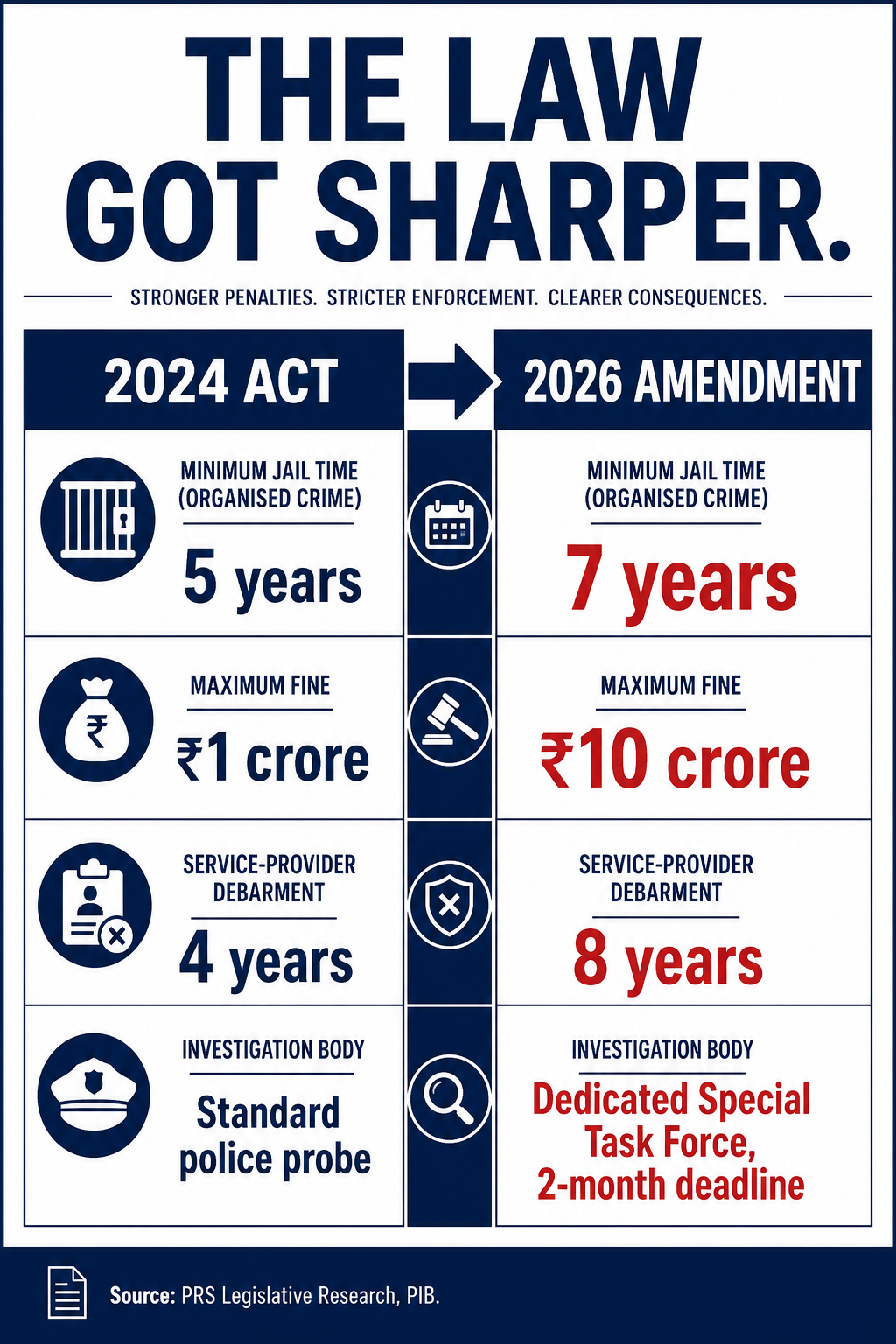
This is the part almost nobody in the protest actually asked for.
This is the part almost nobody in the protest actually asked for.
Not everyone in this story got a reckoning, though. One group got none at all.
A minister resigned. A movement claimed victory. A court weighed in. One group in this story got no reckoning whatsoever, and their names never made it into a single headline. [Find out who →]
What actually ties this together
Both failures share the same shape underneath. The state, and the public, accepted a symbolic resolution in place of a functional one, because the symbolic version is faster to deliver and infinitely easier to photograph. Withdraw a case, and the pressure visibly lifts today. Accept a resignation, and the news cycle calls it justice. Neither requires the slower, unglamorous work of actually fixing the exam-security system, or holding specific people accountable for specific harm — whichever side of the barricade they happened to be standing on.
This was never a story about "the protesters are lawless" or "the government caved." It's a story about a public culture — the state, the opposition, and this movement's own leadership included — that keeps reaching for whatever looks like justice fastest, instead of whatever actually is. A tougher law is real progress. It is not, by itself, order restored.
This isn't only a story about one government's choices. Once the money and the old party ties get named, it stops being one. [Read: Whose accountability, exactly? →]
What repair would actually require
Real repair looks like this:
Fixed, public timelines for the actual institutional fix — exam security, not just a bill's passage through Parliament
FIRs pursued on the evidence, regardless of political cost, in both directions — against protesters, and against any documented police excess, because the same principle has to cut both ways or it isn't a principle
Accountability measured by whether the problem got solved — not by whether someone fell dramatically on their sword in front of a camera
Neither the mob nor the ministry gets to claim the moral high ground here. Both, in the end, took the easy exit — and the bill that cleared both houses of Parliament on 29–30 July 2026 had to do all the work that political courage on either side declined to do.
There's more underneath this than one protest can hold: unemployment versus unemployability, who actually raises a resilient citizen, what the algorithm has done to a generation that grew up inside it. Food for another day, and another essay.
Sources
2026 Delhi Jantar Mantar protests — Wikipedia: en.wikipedia.org/wiki/2026_Delhi_Jantar_Mantar_protests
The Public Examinations (Prevention of Unfair Means) Amendment Bill, 2026 — PRS Legislative Research: prsindia.org/billtrack/the-public-examinations-prevention-of-unfair-means-amendment-bill-2026
Union Minister Dr. Jitendra Singh introduces the Public Examinations Amendment Bill, 2026 — PIB: pib.gov.in/PressReleasePage.aspx?PRID=2290080
"What is the anti-paper leak Amendment Bill all about?" — The Tribune: tribuneindia.com/news/delhi/what-is-the-anti-paper-leak-amendment-bill-all-about
"Public Exams Amendment Bill likely to be tabled in Rajya Sabha today" — ANI: aninews.in/news/national/politics/public-exams-amendment-bill-likely-to-be-tabled-in-rajya-sabha-today-mallikarjun-kharge-targets-amit-shah-over-police-action-on-student-protestors20260730084504
Full source list, including legal and accountability citations, available in the linked deep-dives above.
