The Law Nobody Reads Before They Protest
Everyone has an opinion on what happened at Jantar Mantar. Almost nobody has read the sections that actually governed it — on either side of the barricade.
In May 2026, a leaked NEET-UG paper forced India to cancel its national medical entrance exam mid-cycle. What followed was six weeks of sit-in protest at Delhi's Jantar Mantar, led by a group calling itself the Cockroach Janta Party, that eventually pulled in Sonam Wangchuk and his hunger strike, and ended in a minister's resignation, a Supreme Court order, and a tougher anti-paper-leak law clearing Parliament. Somewhere in the middle of that arc, on 20 July, the protest turned violent — stones thrown, barricades broken, over a hundred police personnel injured, and a crowd surging hard enough that some officers were, by multiple accounts, physically overrun. Almost everyone who watched that day unfold formed an opinion about who was in the right. Almost nobody checked what the law actually says — and the law here doesn't only bind the protesters. It binds the police too, in ways just as specific.
Two rights sit at the center of this story, and both are conditional in ways most people arguing about them seem to forget:
Article 19(1)(a) — freedom of speech, limited by 19(2), which permits "reasonable restrictions" in the interest of public order
Article 19(1)(b) — the right to assemble peaceably, without arms, limited by 19(3) on the same grounds
That phrase, reasonable restrictions, is where almost every argument about this protest actually lives, whether the people having it know it or not.
Ahead of the 20 July march, Delhi Police invoked Section 163 of the Bharatiya Nagarik Suraksha Sanhita — the direct successor to Section 144 of the old CrPC, the colonial-era provision everyone still calls by its retired name out of habit. It lets a magistrate restrict movement or assembly in a defined area when there's apprehension of danger to public order. It is not, and was never meant to be, a blanket ban on dissent — the Supreme Court has said so twice, in two cases that pull in opposite directions and, read together, draw the actual line:
1. Mazdoor Kisan Shakti Sangathan v. Union of India (2018) Peaceful protest cannot be shut down simply because it inconveniences the state. Section 144-style powers exist to prevent actual, demonstrable danger — not to pre-empt embarrassment.
2. Amit Sahni v. Commissioner of Police (2020) — the Shaheen Bagh case Public ways cannot be blocked indefinitely in the name of protest. The right to dissent doesn't come with an unlimited right to occupy.
The two cases don't contradict each other. Protest is protected. Obstruction is not. A magistrate's order restricting movement ahead of a march toward Parliament sits, at least on paper, well inside what the law allows.
That's the assembly side. The conduct side is where it gets more specific — and where most of the outrage on both sides has been aimed at the wrong sections entirely. The Bharatiya Nyaya Sanhita, which replaced the IPC in 2023, isn't gentler toward protest violence than the old code was — if anything it's more granular, as the infographic below lays out section by section.
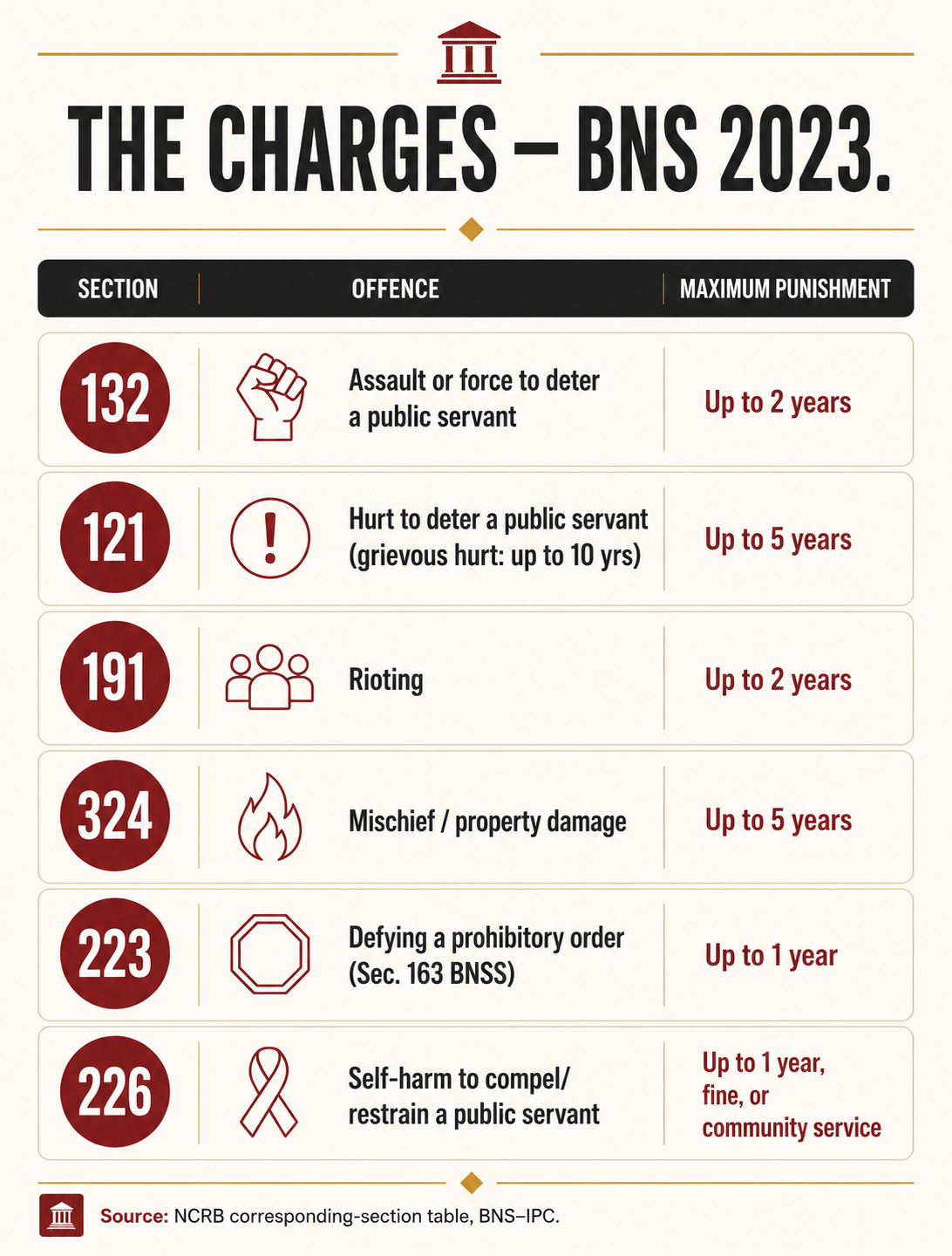
Six sections of the BNS govern what a protester can be charged with. Only one of them didn't exist before 2023.
None of these are new inventions dreamed up for this protest. They were always there, sitting quietly in a code most people never open until it's suddenly being used against someone they know.
One section is genuinely new, though, and worth understanding on its own terms rather than through the lens of any one person. Section 226 of the BNS has no predecessor in the old IPC. It criminalizes attempting suicide specifically to compel or restrain a public servant from performing an official duty — up to one year, or a fine, or community service. It exists because hunger strikes and threatened self-harm have become a recognizable tactic in Indian protest movements, not just at Jantar Mantar but going back decades, and lawmakers apparently decided the tactic itself needed a specific legal answer. It's worth being precise about what this section does and doesn't do: it targets the act of using self-harm as leverage against the state, as a category of protest tactic — not any individual who has used a hunger strike as a form of dissent. General attempted suicide, outside that narrow compulsion context, was already decriminalized nationally under the Mental Healthcare Act, 2017.
Now turn the page around, because the law doesn't stop at what protesters can be charged with. It also, in real and specific detail, tells the police what they're allowed to do to a crowd — and what they aren't.
Chapter XI of the BNSS lays out a graded ladder for dispersing an unlawful assembly, and it is genuinely a ladder, not a switch — set out in full in the infographic below, alongside the one real exception to it.
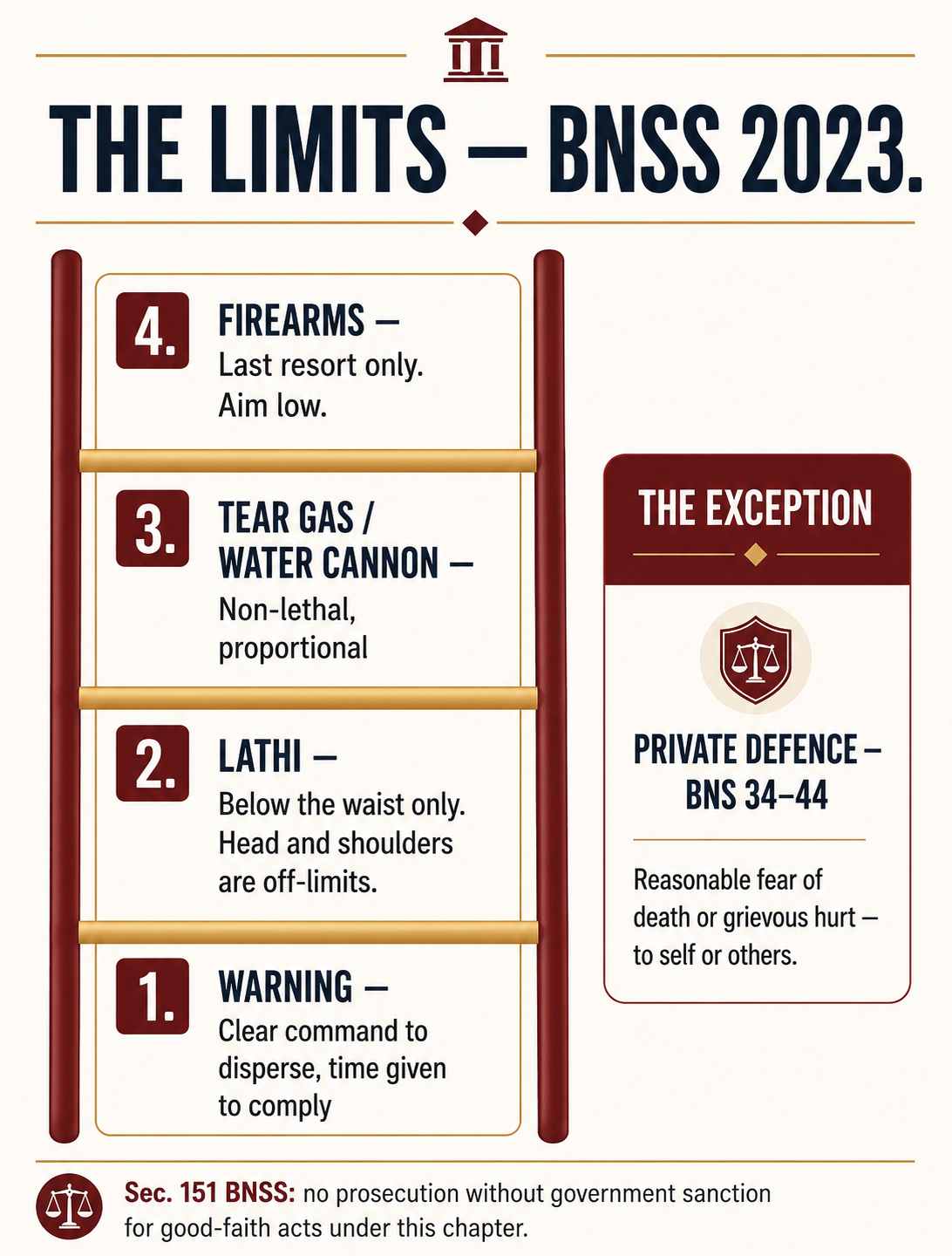
The law doesn't just bind protesters. It tells police exactly how far they're allowed to go — and when that ladder stops applying.
The law tells police exactly how far they're allowed to go — and when that ladder stops applying.
Section 151 backs all of this with real legal weight: no prosecution can even be brought against a magistrate or officer who acted in good faith under this chapter without the government's own sanction first. That's not a technicality. It's a deliberate legal shield, built to let officers do a dangerous job without a lawsuit hanging over every split-second call.
But a crowd-control ladder assumes something the 20 July footage complicates: an officer with room to climb it in order. What the law says about an officer who doesn't have that room — who's being physically overrun, chased, or is watching a colleague get hurt — sits in a different part of the code entirely. The right of private defence, laid out in Sections 34 to 44 of the BNS, is available to every person, uniformed or not, the moment they face a reasonable apprehension of death or grievous hurt to themselves or to someone else, with no realistic time to wait for help. In that narrow, specific circumstance, the law does allow force beyond the ordinary graded response — because the legal question stops being "was this proportionate crowd control" and becomes "was this a genuine response to immediate danger to life." It isn't a blank cheque. The force still has to match the actual threat in the moment, and it stops being protected the instant the danger has passed. But it is real, and it means the picture of that day was never simply "police following a script versus protesters breaking one." Both sides were operating inside rules built for very different situations, and a single afternoon apparently forced both sets of rules to be tested at once.
Nowhere is that tension more alive than in a case that was still being argued the same week this was written. On 30 July 2026, the Supreme Court heard a petition — brought partly by pellet-injury victims from the 20 July march — seeking a ban on pellet guns for crowd control, after reports that officers had used them against protesters that day. The Court declined to ban them outright, holding that as long as the existing police advisory permits pellet guns "in exceptional circumstances," a blanket ban wasn't warranted; one bench member asked, pointedly, how pellets could be barred when firearms themselves are permitted in extreme cases. But the Court didn't wave the specific incident away either. It ordered the Centre to:
Preserve the Rapid Action Force's ammunition logs from that day
Place the actual SOP governing pellet-gun use on record
Ensure medical care for the injured
Left the door open to examine whether this particular use amounted to misuse
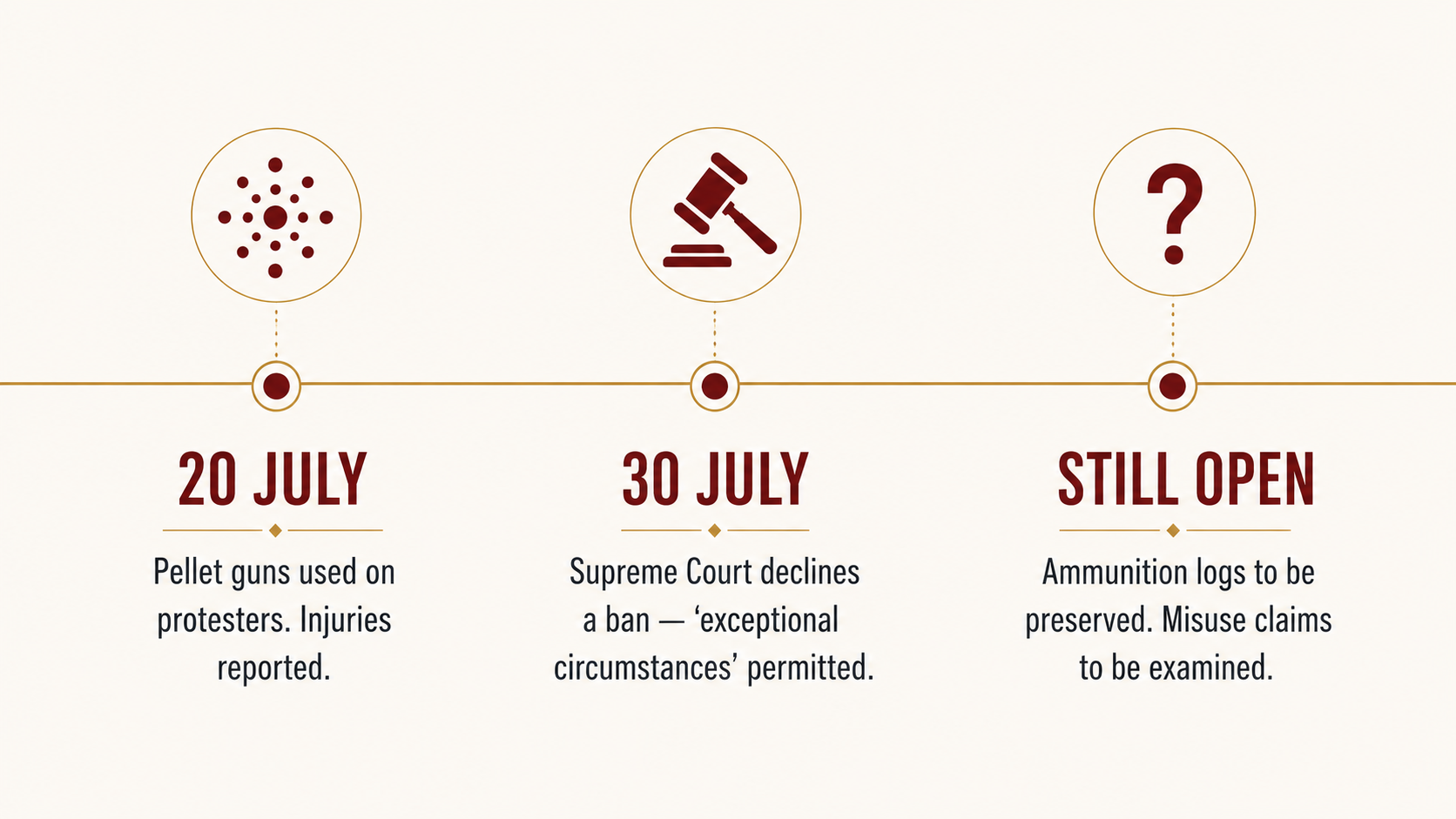
As of this week, the courts still haven't decided whether 20 July was the law working — or a specific case of it being broken.
As of this week, the courts still haven't decided whether 20 July was the law working — or a specific case of it being broken.
Which means the honest answer, as of this week, is that nobody outside that courtroom actually knows yet whether 20 July was the law working inside its lines or a specific, provable case of an officer stepping outside them. The law doesn't resolve that question in advance. It only tells you what standard the answer will eventually be judged against.
Put both halves of this next to each other, and the picture that emerges isn't "the state cracked down" or "the protesters were lawless," and it isn't "the police did whatever they wanted" either. A fairly detailed legal framework already existed on both sides of that barricade — assembly rights and their limits, offences against public servants, a graded ladder for the police to climb, and a private-defence doctrine for the moment that ladder stops being enough. All of it was sitting there, fully equipped to handle exactly what happened at Jantar Mantar, before a single FIR was ever withdrawn as a bargaining chip. The law didn't need to bend for anyone. Someone chose to bend it anyway.
This is part of a series. Start with the original essay: While Tightening the Law, Did We Lose the Order? →
Sources
2026 Delhi Jantar Mantar protests — Wikipedia: en.wikipedia.org/wiki/2026_Delhi_Jantar_Mantar_protests
Mazdoor Kisan Shakti Sangathan v. Union of India (2018) — Supreme Court of India
Amit Sahni v. Commissioner of Police (2020) — Supreme Court of India
Bharatiya Nyaya Sanhita, 2023 — IPC correspondence table, NCRB / UP Police official reference
Bharatiya Nagarik Suraksha Sanhita, 2023 — Sections 148–151 (Chapter XI); Delhi Police 2011 crowd-control SOP
Mental Healthcare Act, 2017 — Section 115
Supreme Court of India, pellet-gun crowd-control petition, order dated 30 July 2026
