The Punishment Got Bigger. The Problem Didn't Move.
Parliament passed a tougher law in four days flat. The last one took two years to fail.
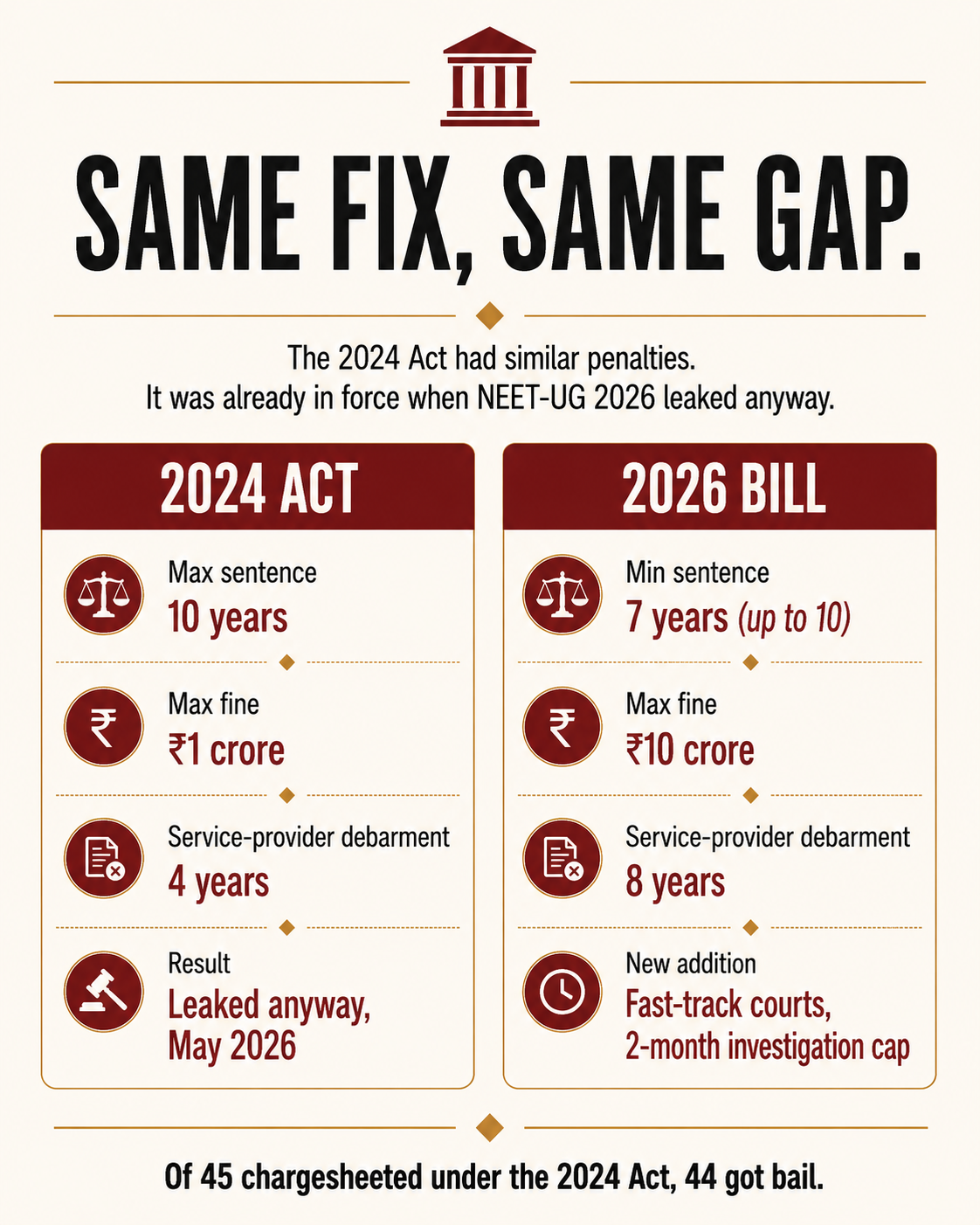
In May 2026, a leaked NEET-UG paper forced India to cancel its national medical entrance exam. Six weeks of protest followed at Jantar Mantar, ending in a minister's resignation and, on 29–30 July, the Public Examinations (Prevention of Unfair Means) Amendment Bill, 2026 clearing both houses of Parliament. It sharpens the law considerably:
Minimum imprisonment raised from 5 to 7 years, extendable to 10, for organised exam crime
Maximum fine raised from ₹1 crore to ₹10 crore
Service-provider debarment extended from 4 to 8 years
A Special Task Force, empowered to investigate directly
Two-month investigation deadlines, day-to-day trials, and a three-month cap on both trial and appeal
On the day it passed, this looked like exactly the kind of decisive institutional response this series has spent five essays arguing India rarely produces. It's worth asking, honestly, whether it actually is one.
Here's the fact almost nobody sat with while this bill moved through Parliament: it isn't the first time this exact fix was tried. The Public Examinations (Prevention of Unfair Means) Act, 2024 — passed after the original NEET-UG scandal, in force since 21 June 2024 — already carried penalties in the same range: up to 10 years imprisonment, fines up to ₹1 crore, a four-year debarment for service providers, cognizable and non-bailable offences. It was, at the time, treated exactly the way this new bill is being treated now — as the decisive fix. It was already in force, in full, when the NEET-UG 2026 paper leaked. Whatever deterrent effect a 10-year sentence and a 1-crore fine were supposed to have, it didn't survive contact with whatever actually causes a paper to leak.
So the honest question this piece has to ask isn't "is the new law tough enough." It's: if toughness wasn't the bottleneck last time, why would more of it be the fix this time?
The answer sits in how a leak actually happens, and it's more complicated — and more commercial — than one corrupt official selling a PDF. Investigative reporting on both the 2024 and 2026 leaks describes something closer to a distributed supply chain than a single crime:
A paper moves from setter, to printing press, to strong room, to bank locker, to police custody, to the exam centre — each handoff a point of vulnerability
The person who first leaks it is only "the first supplier" — coaching networks are what give a stolen paper its actual commercial value
A full operation has reportedly involved school officials, trunk-openers, MBBS-student solvers, guest-house operators, candidate recruiters, printers, transporters, money handlers, and digital resellers — an entire cottage industry, not a lone actor
Organised coaching hubs with a documented pattern of this exact business exist in Bihar, Jharkhand, Rajasthan, and Gujarat
A 10-year sentence is a real deterrent for the person caught holding the paper. It does very little to a commercial network built around the scarcity of seats and the desperation of students — the actual engine, per multiple analyses, driving the whole economy of leaks. Raising the penalty at the end of the chain doesn't touch the demand that funds every link before it.
That demand has three separate faces, and treating it as one thing understates the problem. There's the desperation of students and families facing genuinely brutal odds in a high-stakes, low-seat system — sympathetic, and not really the target of any penalty. There's the coaching industry itself, which isn't a neutral bystander selling test prep: a scarce, high-stakes, leak-prone exam is precisely the condition that makes coaching feel indispensable, and a genuinely secure, low-anxiety exam system would threaten a business model built on exactly the fear this piece has been describing. And there's a third face, harder to admit and proven by India's own history: the political cost of actually stopping it.
In 1992, Uttar Pradesh's BJP government under Chief Minister Kalyan Singh passed the Anti-Copying Act — mass cheating made a cognizable, non-bailable offence, with police empowered to enter exam halls directly. It worked, in the narrowest and most literal sense: pass rates in the state's board exams collapsed to roughly 15% for intermediate and 30% for high school that year, and 17% of registered students walked out mid-exam rather than sit it without help. The BJP lost the following state election, and the Anti-Copying Act is widely cited as one of the reasons why. The Samajwadi Party-BSP government that replaced it repealed the law within a year and reinstated the "self-centre" system — students sitting board exams inside their own school, which functionally reopens the door to organised local cheating. It's worth being fair to the full history here: BJP itself reintroduced a milder version of the law in 1998, which reportedly had little real impact — so this isn't a clean story of one party's courage against another's cynicism. It's evidence that no government, of any party, has yet found a version of "actually stopping this" that survived contact with an election.
That's the uncomfortable ceiling sitting above every bill like this one. A law can raise sentences and speed up trials indefinitely. It can't, by itself, change an electorate's revealed preference for a system permissive enough to route around inconvenience — and until some government is willing to test that preference again, at the ballot box, "toughening the law" will keep being the version of reform that costs nothing to pass and asks nothing of anyone who benefits from the system staying exactly as leaky as it is.
The implementation record backs this up more than any theory does. Of the 45 people chargesheeted in the original 2024 NEET-UG leak case, 44 had already received bail by the time this new bill was being debated. A ten-year maximum sentence written into a statute means very little if the actual cases moving through the system aren't keeping anyone behind bars while they're tried. This is the real gap the new bill's fast-track courts are trying to close — two-month investigation caps and day-to-day trials exist specifically because a law that's tough on paper and slow in practice ends up functioning as neither. That's a fair, substantive defense of what the bill actually does well, and it deserves to be weighed alongside the criticism, not erased by it.
It's also fair to ask, separately, why NTA leadership survived multiple rounds of controversy essentially unchanged. A body that runs the exam is presumably also the body best positioned to explain why the exam kept failing — and continuity at the top, while the exam beneath it kept leaking, is itself a data point about whether real internal accountability exists, distinct from whatever penalty gets attached to outside offenders.
There's a genuine irony worth sitting with, independent of who said what in Parliament. CJP's own spokesperson, Ashutosh Ranka, made almost this identical critique in real time, days before the bill was introduced: that the government was focused on "what punishment should be given after a paper leak occurs" while never addressing "why paper leaks are happening in the first place." He was arguing it to demand the minister's removal, not a systemic redesign — but the diagnosis is the same one this piece is making from a completely different starting point. A protest built almost entirely around a resignation, and a legislative response built almost entirely around raising penalties, converged on the same evasion from opposite directions: both found it easier to escalate consequence than to address cause.
None of this means the new bill is worthless. Two-month investigation deadlines and day-to-day trials are genuine, structural improvements — India's problem with exam-fraud cases has historically been less "penalties too light" and more "cases that vanish into years of procedural drift before anyone is ever actually punished." Speed is a real fix for a real problem. So is the NTA's quieter, less photographed operational layer — police-escorted paper transport, CCTV at exam centres, biometric verification, tighter coaching-hub monitoring, a dedicated portal for reporting fake leak claims. None of that made a headline. Almost all of it addresses the actual supply chain in a way a fine never will.
Concurrent List math applies here too, briefly: because education sits jointly with the states, a Parliament-passed law applies nationwide uniformly on paper — but its actual enforcement, the printing presses, the transport routes, the exam-centre security, still runs through machinery every state controls separately. A national deterrent is only as strong as its weakest state's implementation.
What repair would actually require isn't a mystery, and it isn't primarily a sentencing question:
Funding and staffing the operational layer — the CCTV, the biometrics, the escorted transport — with the same urgency and coverage as the headline penalties
A real accounting of the 2024 Act's committee and its findings, instead of a new committee every crisis cycle
Attacking the demand side — the coaching economy that turns a stolen paper into a commercial product, not just the supply side that a prison sentence targets
A functioning, funded Special Task Force, not just an empowering clause sitting in a bill
A government willing to pay the electoral cost that "actually stopping it" has apparently always carried, since 1992 — the one ingredient no law can legislate into existence
The punishment got bigger this week. Whether the problem gets smaller depends entirely on whether anyone follows through on the parts of this story that don't come with a press conference attached.
This is part of a series. Start with the original essay: While Tightening the Law, Did We Lose the Order? →
Sources
Public Examinations (Prevention of Unfair Means) Amendment Bill, 2026 — PRS Legislative Research bill summary
Public Examinations (Prevention of Unfair Means) Act, 2024 — Government of India, in force from 21 June 2024
"Paper leaks continue despite 2024 law; new Bill will fail again" — ThePrint, 28 July 2026
"How coaching networks enabled the NEET paper leaks of 2024 and 2026" — OpIndia, July 2026
"Why Are Papers Leaked In India?: Supply Chain, Capacity, and Incentives" — The Geostrata, July 2026
Anti-Copying Act, 1992 (Uttar Pradesh) — Wikipedia; "Why Kalyan Singh's Anti-Copying Act Was More Important Than You Think" — Swarajya
"Mulayam Singh Yadav abolishes Anti-Copying Act in Uttar Pradesh" — India Today, 30 June 1994
"No discussion on why leaks happening," Ashutosh Ranka, CJP — ANI, 23 July 2026
Constitution of India, Seventh Schedule, Concurrent List
