The Officers Nobody's Asking About
118 of them were hurt. Not one of them made it into a headline as a person.
In May 2026, a leaked NEET-UG paper forced India to cancel its national medical entrance exam mid-cycle. The fallout ran for six weeks at Delhi's Jantar Mantar — a sit-in led by the Cockroach Janta Party that grew to include Sonam Wangchuk's hunger strike, national media coverage, and eventually a minister's resignation. On 20 July, thousands of protesters tried to march on Parliament in defiance of prohibitory orders, and the clash that followed is the part most retellings dwell on: batons, tear gas, stones, barricades broken. What most retellings skip is who was standing on the other side of that barricade line.
Every account of that 20 July clash leads with the same numbers, and they're worth sitting with for a second rather than skimming past — laid out in full below
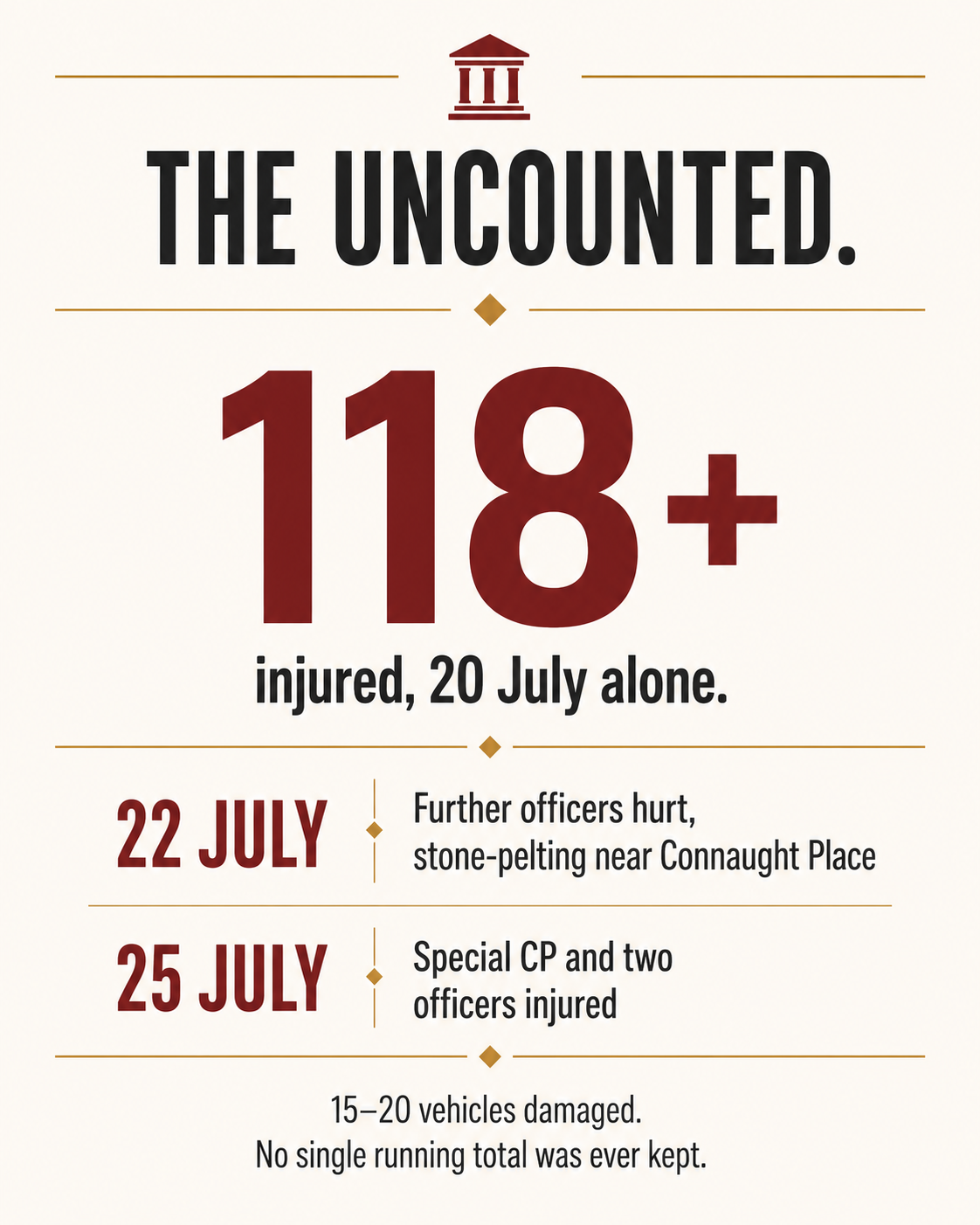
118+ injured on 20 July alone. No single running total was ever kept.
Officers overrun by a crowd large enough that batons and tear gas were the tools available, not because anyone wanted a violent afternoon, but because that's what's left once a barricade line breaks.
Every one of those 118 people went home that night — or didn't go home, and went to a hospital instead — carrying an injury that will heal, mostly, the way bruises and cuts heal. What won't get any coverage at all is the part where their side of that day simply never became a story. Not one name. Not one interview. Not one photograph that ran wider than a wire caption.
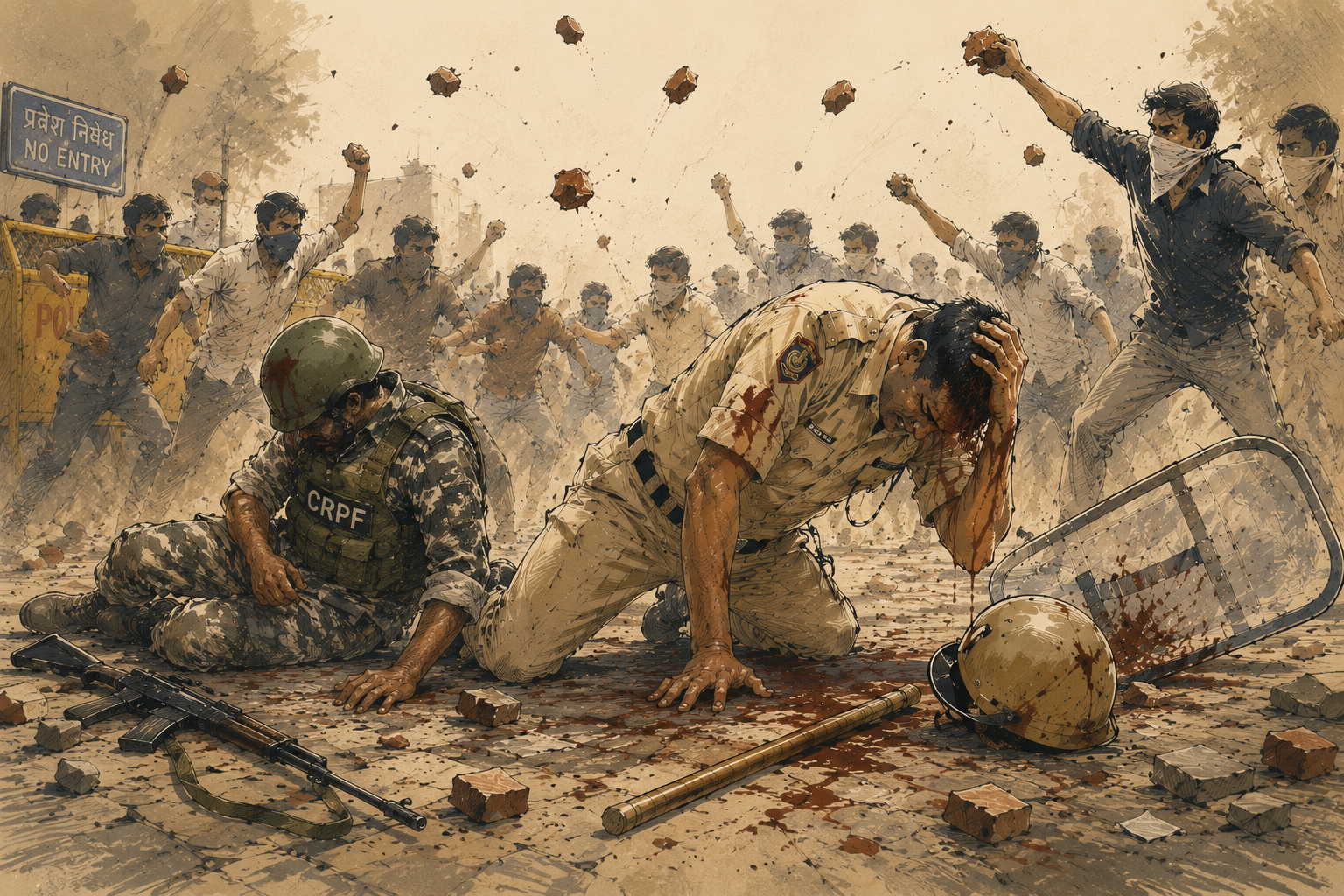
Nobody counted this moment. They just counted the total.
This isn't a call to swing the sympathy the other way — nobody needs a competing hunger strike staged for police morale. It's a narrower point, and it's a legal one as much as a moral one. Article 21 of the Constitution guarantees the right to life and personal dignity to every person — a phrase the courts have read expansively for everyone from undertrials to sex workers to prisoners on death row. There's no carve-out in that reading that excludes a police constable standing in a cordon. The dignity argument that animates most protest-rights writing — that a person forced to endure violence deserves to be seen, not just tallied — applies with exactly the same force to the person standing on the other side of the barricade, doing a job nobody particularly envies, for a salary nobody's protesting to raise.
The Bharatiya Nyaya Sanhita actually agrees with this, on paper. Section 132 and Section 121 exist specifically because assaulting or injuring someone in the course of their public duty is treated by the law as a distinct wrong — not just ordinary hurt, but hurt aimed at making the state itself flinch. That's a real legal recognition that these officers occupy a protected category. It just doesn't seem to have translated into anyone treating them as protected in the version of this story that got told.
Part of this is structural, not sinister. A protester with a grievance has a name, a face, a reason the camera wants to follow them. A police line has a uniform, a formation, a number in a press release. It's simply easier to make a person out of the first and a statistic out of the second — nobody sets out to do it, the format just tilts that way every time.
But easier isn't the same as fair. If accountability in this story means anything — and the previous essay in this series argues it barely meant anything at all — it has to mean asking what happened to the individual officers hurt that day, not just filing them under a total. Whether any of them needed real medical follow-up. Whether the department did anything for them beyond a press-release headcount. Nobody's asked, largely because nobody thought to.
That's not an accusation aimed at the protesters, most of whom were there for a genuine grievance and never went near a barricade. It's an observation about a public conversation that had room for a minister's resignation, a Supreme Court order, and a hunger strike that pulled the whole country's attention — and no room at all left over for 118 people whose names we still don't know.
This is part of a series. Start with the original essay: While Tightening the Law, Did We Lose the Order? →
Sources
2026 Delhi Jantar Mantar protests — Wikipedia: en.wikipedia.org/wiki/2026_Delhi_Jantar_Mantar_protests
Bharatiya Nyaya Sanhita, 2023 — Sections 121, 132
Article 21, Constitution of India